
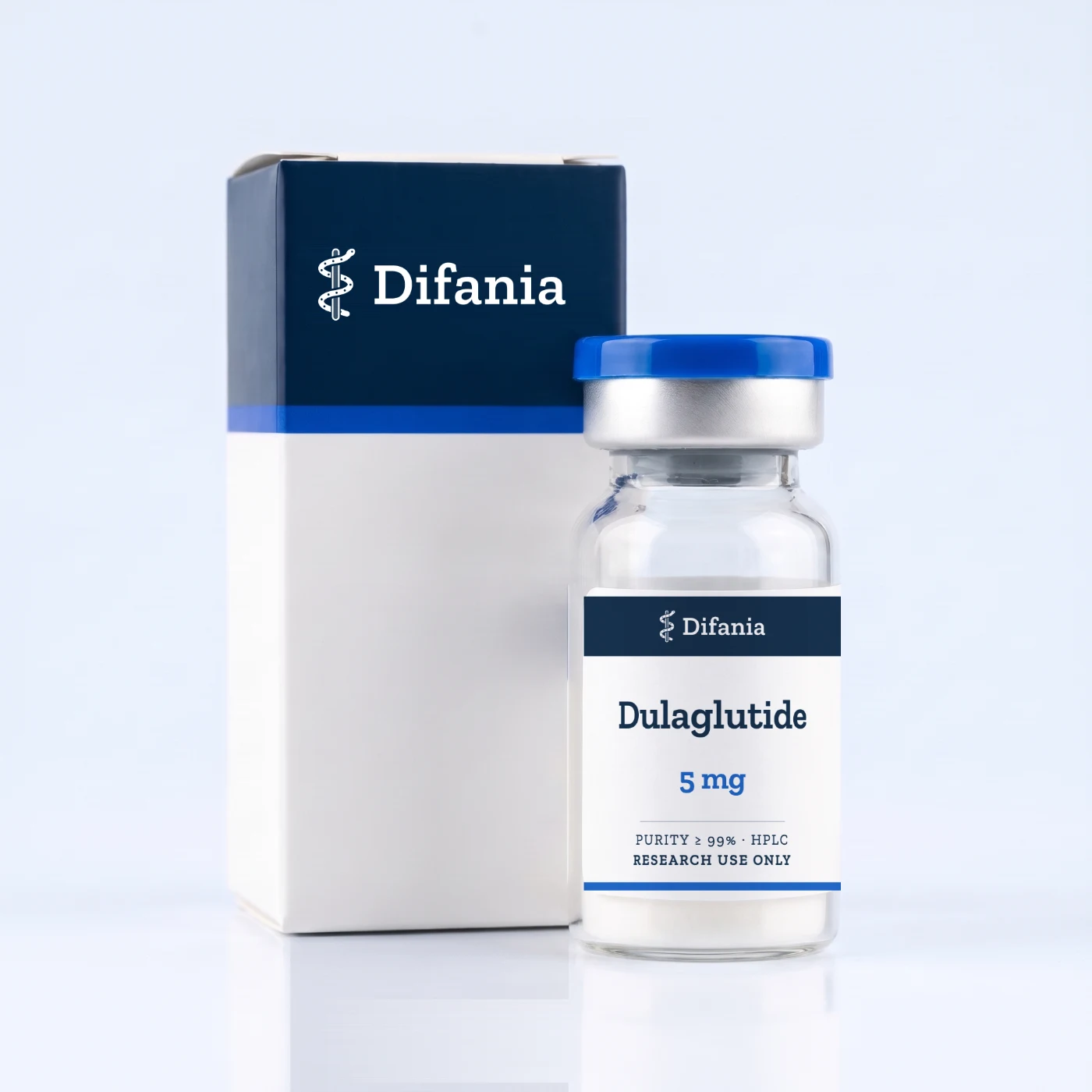
Dulaglutide in the laboratory
Identification
Dulaglutide is catalogued under incretin analogues and supplied as a lyophilised solid in a sealed glass vial, in two fill weights, 5 mg and 10 mg. The catalogue holds one specification for the material, a purity of 99% or higher, and it records no CAS number, molecular formula, molar mass or sequence, so none is quoted here. For an item of this kind identity is carried by the analytical data generated for each lot rather than by a published identifier, which makes the lot number on the label the practical reference point for everything that follows.
Two things about the dry material are worth knowing before the first vial is opened. A freeze dried peptide solid is extremely light and may sit as a thin film against the wall of the vial rather than as a visible pellet, so a vial that looks empty on arrival is behaving normally. And the solid is far more forgiving than the solution, which is why the material is supplied dry and dissolved only at the point of use.
Analytical control
Two methods stand behind release, and they answer different questions. Reversed phase high performance liquid chromatography separates the main component from related substances and process residues; the main peak is integrated against the whole chromatogram and the figure is read against the catalogue specification of 99% or higher. Mass spectrometry confirms that the material separated in that run is the compound named on the label, by measuring its mass against the value expected for the synthesised peptide.
Both results carry the lot number, so what a buyer can request is the record for the vial in hand and not a general statement about the catalogue entry.
Reconstitution and solubility
Allow the vial to stand until it has reached room temperature, then break the seal. Direct the solvent slowly down the inner wall so that it does not fall onto the solid, and swirl gently, or leave the vial standing, until the cake has cleared. Shaking and vortex mixing are best avoided with peptide solutions.
| Vial | Solvent added | Resulting concentration |
|---|---|---|
| 5 mg | 1 mL | 5 mg/mL |
| 5 mg | 2 mL | 2.5 mg/mL |
| 10 mg | 2 mL | 5 mg/mL |
Any other volume is just as valid; the concentration is arithmetic. Bacteriostatic water is the usual solvent for a stock that will be sampled repeatedly, sterile water for one consumed in a single session, and a dilute acetic acid solution where the solid resists plain water.
Storage and stability
Sealed and solid, the vial belongs in a freezer at minus 20 degrees Celsius, protected from light, and stays there until the day of use. Reconstituted material is held at 2 to 8 degrees Celsius and is best divided into single use portions at the moment it is prepared. What usually costs a laboratory part of a vial is not time on the shelf but repeated cycles of warming and cooling, and portioning removes most of them. Bring a cold vial to room temperature before opening it, and write the date of reconstitution on the label.
Use in the laboratory
The reagent is supplied for in vitro work and for use as a reference material when analytical methods are being developed or verified against a characterised solid. The incretin analogues as a group are a subject of metabolic and endocrine research. Difania supplies the material and the analytical documentation held for its lot, and does not advise on experimental design, which stays with the laboratory doing the work.
Safety and handling
Wear gloves and eye protection while the vial is open and while solutions are being made up. Residues, spent solutions and used vials are disposed of under institutional rules and the local regulations covering chemical waste. The material is a research chemical: not a medicinal product, food, supplement or cosmetic, and not for consumption or for administration to humans or animals.
Lot documentation
Each vial carries a lot number, and that number is what unlocks the analytical documentation Difania holds for the batch. Quote it in any request and the records for that lot can be retrieved. Copy it into your own log alongside the date the vial was opened, so the material behind a later result remains identifiable. Orders placed by 14:00 on a business day are dispatched the same day.


