
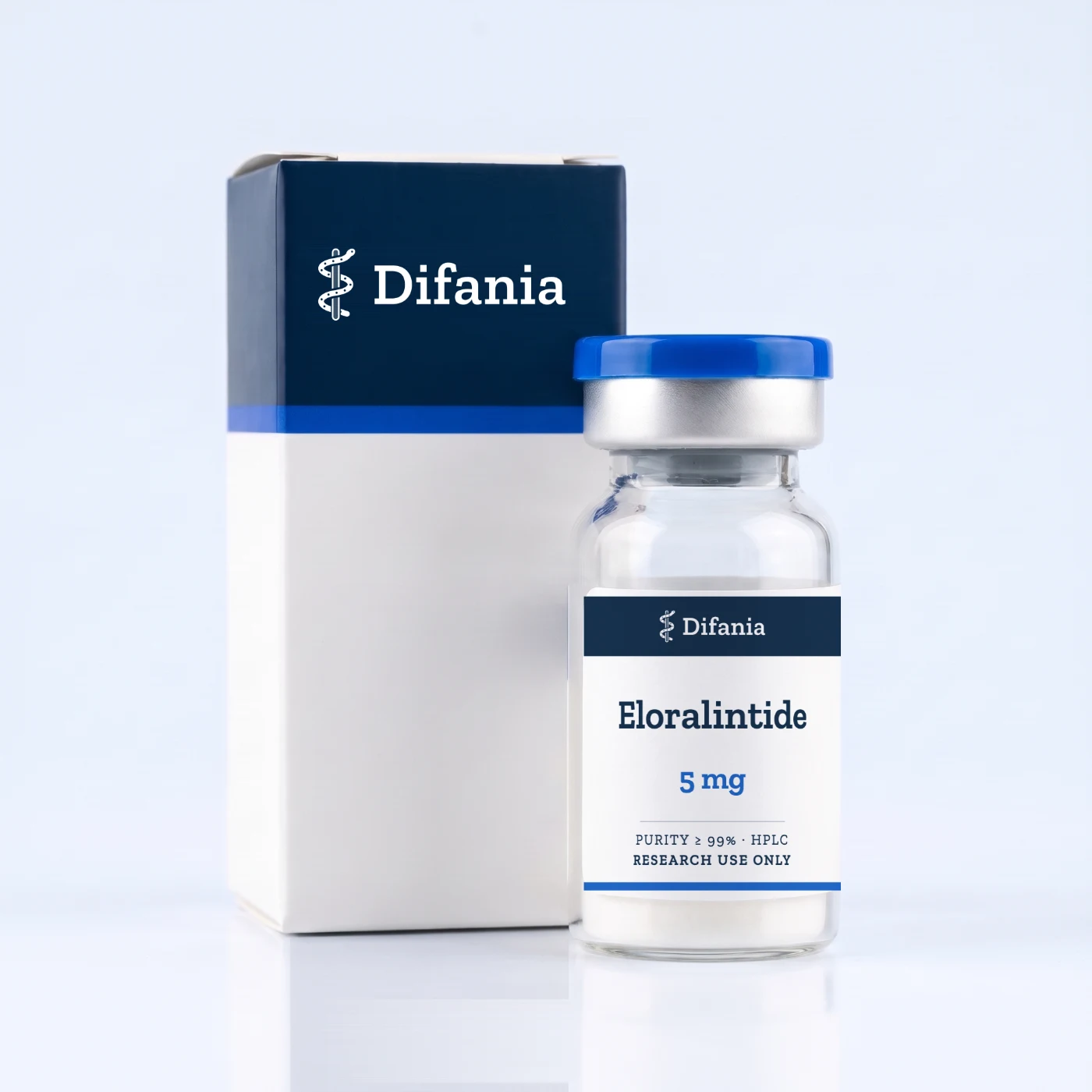
Eloralintide in the laboratory
Identification
Eloralintide is catalogued by Difania under incretin analogues and is supplied as a lyophilised solid in a sealed vial. Two fill sizes are listed, 5 mg and 10 mg of peptide, and both are held to a single quality figure, a purity of 99% or higher. No CAS number, molecular formula, molar mass or amino acid sequence is entered against this item in the catalogue, and none is stated here. Identity for this entry therefore rests on the analytical work performed on each lot rather than on a registry identifier, and where a chemical register or a goods inward record needs a reference, the lot paperwork is the right source. The peptide is sold as a single material and is not listed as a component of any combined vial in the range. As with other freeze dried peptides, the solid is light and low in bulk, so a vial that looks nearly empty is holding its full stated quantity.
Analytical control
Each lot is characterised before it is released. Reversed phase HPLC separates the peptide from related substances and from process residues, and the main peak is integrated against the whole chromatogram and judged against the catalogue specification of 99% or higher. Mass spectrometry then confirms that the material in the vial is the peptide it is catalogued as, by measuring its mass against the value expected for the synthesised chain. The two results sit together in the lot record, and that record is what Difania can produce for any vial whose number you quote.
Reconstitution and solubility
Let the vial reach room temperature before the seal is broken. Add solvent slowly down the inner wall rather than straight onto the cake, then swirl gently or leave the vial standing until everything has gone into solution. Shaking and vortexing are best avoided while solid is still visible.
| Vial size | Solvent added | Resulting concentration |
|---|---|---|
| 5 mg | 1 mL | 5 mg/mL |
| 5 mg | 2 mL | 2.5 mg/mL |
| 10 mg | 1 mL | 10 mg/mL |
| 10 mg | 2 mL | 5 mg/mL |
Bacteriostatic water, sterile water and a dilute acetic acid solution are the solvents normally reached for, the acid route being the one kept for a solid that clears slowly in water on its own.
Storage and stability
Hold unopened vials at minus 20 degrees Celsius, in the dark, with the seal intact until the work is ready for them. A solution, once made, belongs at 2 to 8 degrees Celsius and should be split into working portions at the point of preparation, which spares the whole stock from being warmed and returned to the cold again and again. Bringing a vial up to room temperature before opening it stops moisture settling on the cold contents.
Use in the laboratory
This material is intended for in vitro experiments and for service as a reference standard, for instance when a chromatographic method is being set up or checked against a known input. Incretin analogues are a class met in metabolic and receptor pharmacology research, and the entry is catalogued for laboratories working in that field. What Difania supplies is the reagent and the analytical documentation recorded for its lot. Difania does not advise on experimental design and does not interpret results.
Safety and handling
This is a laboratory chemical and should be treated as one throughout. Wear gloves and eye protection while the vial is open and while solutions are transferred, and keep handling of the dry solid inside the containment your laboratory normally uses for fine powders. Residues, used solutions and empty glassware are disposed of according to your institution’s rules and the local regulations covering laboratory waste. It is not a medicinal product, a food, a supplement or a cosmetic, and it is not for consumption or for administration to humans or animals.
Lot documentation
Each vial leaves with a lot number printed on its label. That number ties the vial to the analytical documentation Difania holds, and quoting it is enough for those records to be found. Note it in your laboratory record alongside the date the vial was opened, so that a result obtained weeks later can still be matched to the lot and the fill size it came from.


