
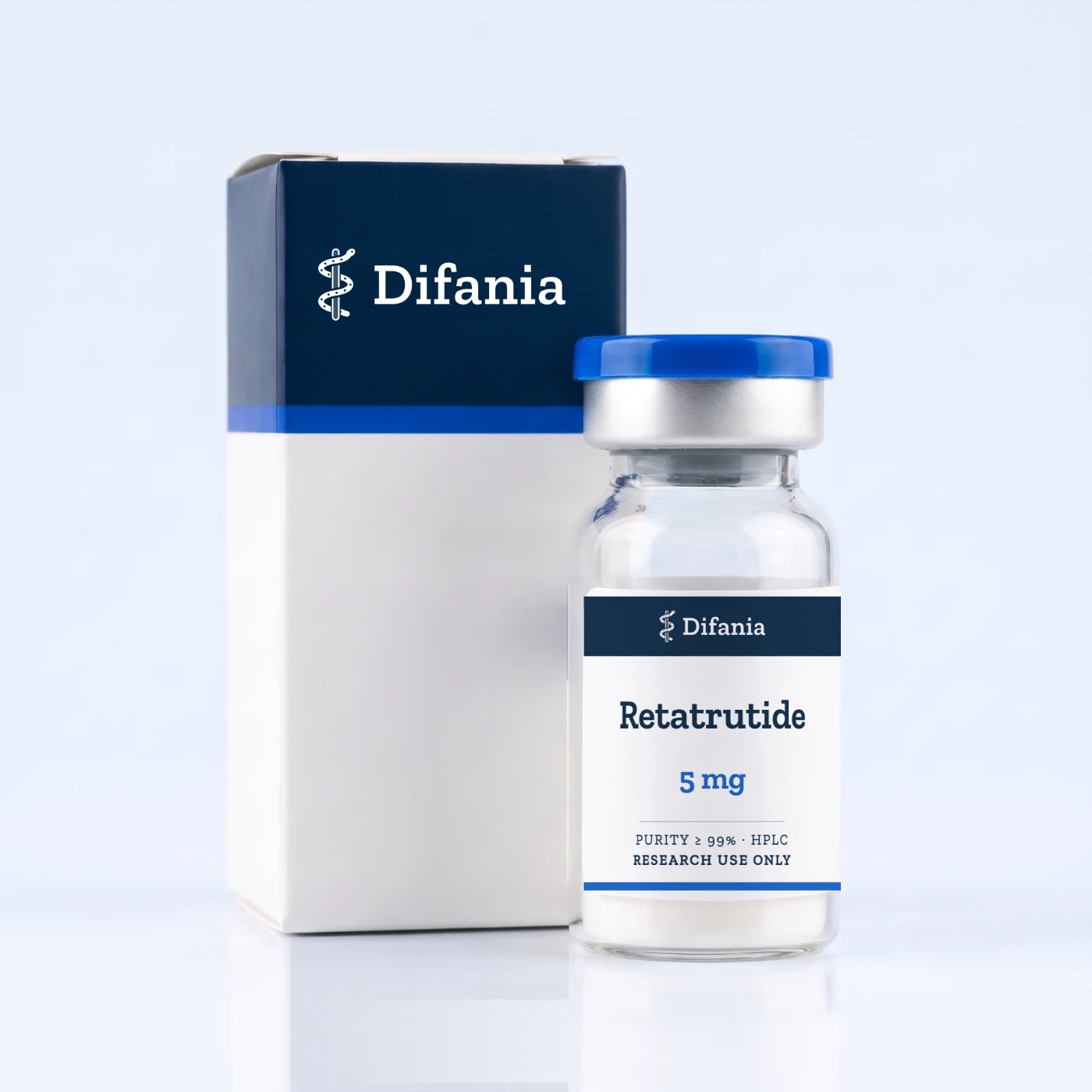
Retatrutide in the laboratory
Identification
Retatrutide is a synthetic peptide held in the incretin analogue group of the catalogue and supplied as a lyophilised solid. The record carries CAS 2381089-83-2, the molecular formula C221H342N46O68 and a molar mass of 4731.3 g/mol.
That formula says more at the bench than its length suggests. A chain built on two hundred and twenty one carbon atoms with sixty eight oxygen atoms is long and strongly polar, which is why an aqueous solvent is the first thing reached for and why the dry cake takes up moisture from the air. No sulphur appears in the formula, so the solid carries neither a free thiol nor a disulphide bridge: no reducing agent and no inert atmosphere are needed when the seal is broken.
The molar mass also fixes the arithmetic a laboratory does on receipt. At 4731.3 g/mol, one milligram of solid is close to 0.21 micromoles, so a 5 mg vial holds roughly 1.1 micromoles and a 100 mg vial roughly 21 micromoles. Nine fill weights are catalogued, 5 mg, 10 mg, 15 mg, 20 mg, 30 mg, 40 mg, 50 mg, 60 mg and 100 mg, all the same material under the same specification. The same peptide is also catalogued inside a two component vial, Retatrutide + Cagrilintide, where it is freeze dried together with a second peptide.
Analytical control
Release rests on two independent measurements, neither of which can be read off a label.
Identity comes from mass spectrometry. The measured mass is set against 4731.3 g/mol, the value calculated from the structure. A chain of this size leaves little room for ambiguity, because one residue too few or too many shifts the result by far more than the uncertainty of the measurement.
Purity comes from reversed phase high performance liquid chromatography, which separates the target peptide from truncated chains, deletion sequences and residues left by the synthesis. The specification is 99% or higher, read as the area of the main peak against the total area under the chromatogram. What sits outside the main peak is a profile of related species rather than an unknown, which is why the chromatogram itself repays reading.
Reconstitution and solubility
The cake takes up an aqueous solvent without warming and without a vortex mixer. Run the liquid down the inside wall of the vial rather than straight onto the solid, let it stand for a minute, then swirl until the solution has cleared. Foam on the surface means the peptide has been shaken rather than dissolved.
| Vial | Solvent added | Resulting concentration |
|---|---|---|
| 5 mg | 2 mL | 2.5 mg/mL |
| 15 mg | 3 mL | 5 mg/mL |
| 40 mg | 8 mL | 5 mg/mL |
| 100 mg | 10 mL | 10 mg/mL |
Nothing in the table is a recommendation. It is division, and any other volume is equally valid.
Storage and stability
Sealed solid: minus 20 degrees Celsius, dry and shielded from light. Working solution: 2 to 8 degrees Celsius, split into single use portions at the moment it is made. Before opening: let the vial stand until it has reached room temperature, since cold glass draws water out of the air and the solid takes it up. Repeated freezing and thawing, rather than time on the shelf, is what usually costs a laboratory part of a vial.
Use in the laboratory
The reagent is supplied for in vitro work and for use as a reference material while analytical methods are being developed. Retatrutide appears in metabolic research, where peptides of this group are examined in cell based systems, and in work on separation and detection methods for long synthetic chains. Difania supplies the material together with the analytical documentation held for its lot, and does not design experiments or advise on how they should be run.
Safety and handling
Gloves, eye protection and a clean bench. The lyophilised solid is light and easily disturbed, so open the vial where no draught crosses it. Residues, empty vials and contaminated consumables go into laboratory waste under the rules of your institution and the local regulations that apply to it. This is a chemical reagent: not a medicinal product, not a food, not a food supplement, not a cosmetic, and not intended for consumption or for administration to humans or animals.
Lot documentation
A lot number is printed on every vial. Quote it to Difania and the analytical documentation held for that lot can be retrieved against it, the HPLC result and the mass spectrometric confirmation included. Copy the same number into your own log beside the date the vial was opened and the solvent used, so that a result obtained months later still points back to a defined material.


