
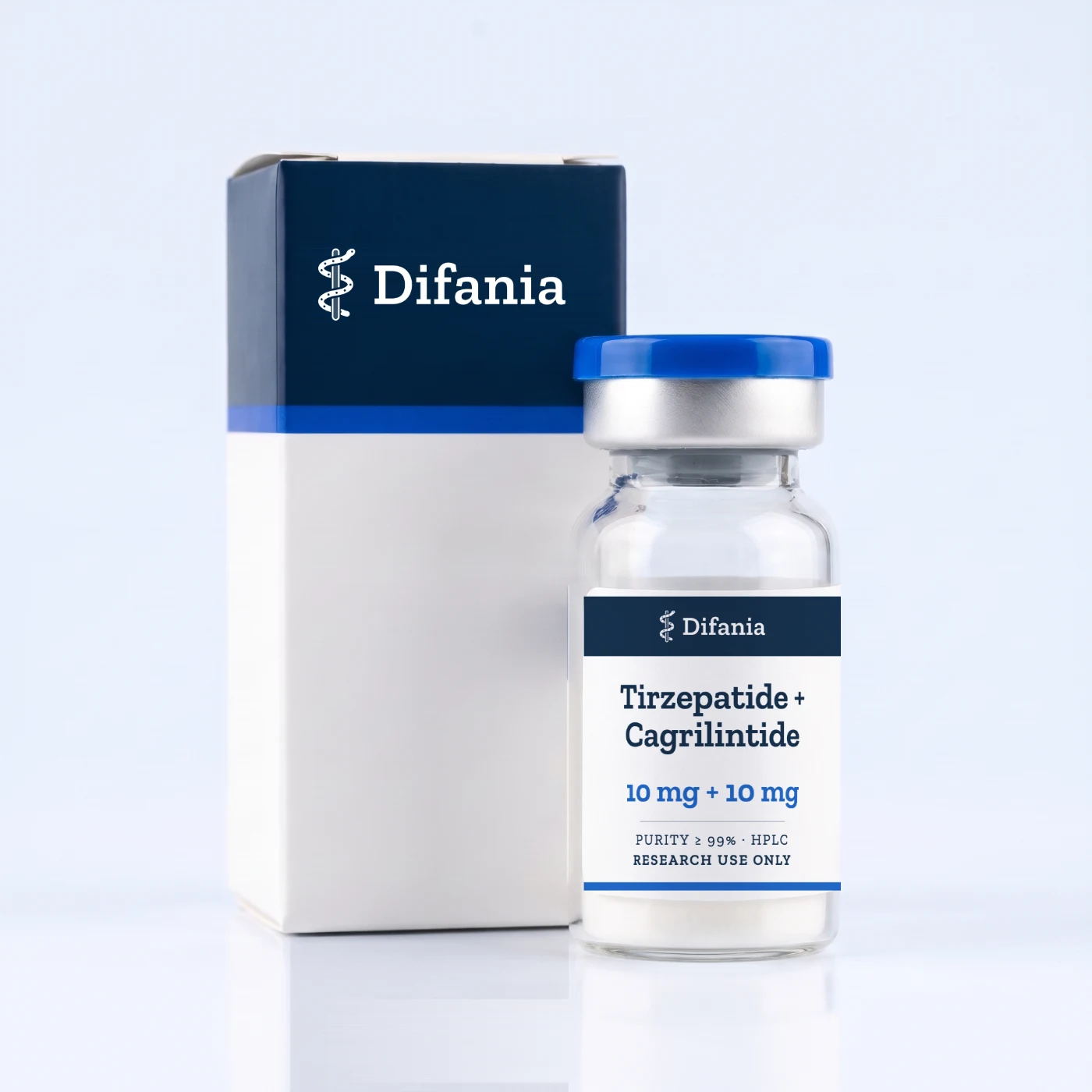
Tirzepatide + Cagrilintide in the laboratory
Composition
The vial holds two synthetic peptides, tirzepatide and cagrilintide, lyophilised together so that one cake contains both. The catalogue places it among the incretin analogues and lists a single fill weight: 10 mg + 10 mg, that is 10 mg of tirzepatide and 10 mg of cagrilintide in the same sealed container, in equal amounts.
Because there is only one fill weight, the planning a buyer does happens at reconstitution rather than at the order. The whole vial dissolves in one step, and whatever volume of solvent is chosen sets the concentration of both peptides at once. The ratio between them was fixed when the material was dried and cannot be altered later, nor can either component be recovered on its own from the solution. That is the trade a co-lyophilisate makes: the weighing of two solids, and the error that comes with it, is replaced by a single defined vial, at the cost of the freedom to vary the proportion.
Analytical control
Release rests on two measurements that answer separate questions. Reversed phase high performance liquid chromatography establishes purity: the material is separated on the column, each main peak is integrated against the full chromatogram, and the result is read against the catalogue specification of 99% or higher. Mass spectrometry establishes identity, comparing the measured mass of each component with the mass expected for that peptide.
Chromatography says how much of what is in the vial is the intended material without naming it. The mass measurement names it without describing what else is present. Neither is sufficient on its own, which is why both appear in the documentation held for a lot.
Reconstitution and solubility
Take the vial from cold storage and leave it until it is at room temperature. Direct the solvent down the inner wall of the vial so that it does not land on the solid, then swirl gently, or simply let the vial stand, until the cake has cleared. Do not shake and do not apply a vortex mixer to undissolved solid.
For this fill weight the arithmetic is short: 1 mL gives 10 mg/mL of each component, 2 mL gives 5 mg/mL of each, 4 mL gives 2.5 mg/mL of each. Bacteriostatic water is the usual solvent for a stock that will be drawn on repeatedly, sterile water for one made up and used in a single session, and a dilute acetic acid solution where the solid resists plain water.
Storage and stability
The sealed solid is kept at minus 20 degrees Celsius, dry and protected from light, and stays sealed until the day of use. Once the cake has gone into solution, hold it at 2 to 8 degrees Celsius and divide it into single use portions at the point of preparation. Repeated cycles of warming and cooling, rather than time on a shelf, are what usually cost a laboratory part of a vial. Equilibrate a cold vial to room temperature before opening and label it with the date it was made up.
Use in the laboratory
The material is supplied for in vitro work and as a reference material in analytical and method development work, where a characterised solid of known composition is needed for calibration and comparison. Peptides catalogued as incretin analogues are a subject of metabolic and endocrine research. Difania supplies the vial together with the analytical documentation held for its lot and does not advise on experimental design.
Safety and handling
The contents are a laboratory chemical and are handled as one. Gloves and eye protection are worn while the vial is open and while solutions are prepared, and residues, spent solutions and used vials go into chemical waste under institutional rules and the local regulations that apply. The material is not a medicinal product, food, supplement or cosmetic, and it is not for consumption or for administration to humans or animals.
Lot documentation
Every vial is marked with a lot number. Quote it to Difania and the analytical documentation held for that lot can be retrieved. The number is worth entering in your own log next to the date the vial was opened and the solvent used, so that a result obtained later can still be traced to the exact material behind it.


