
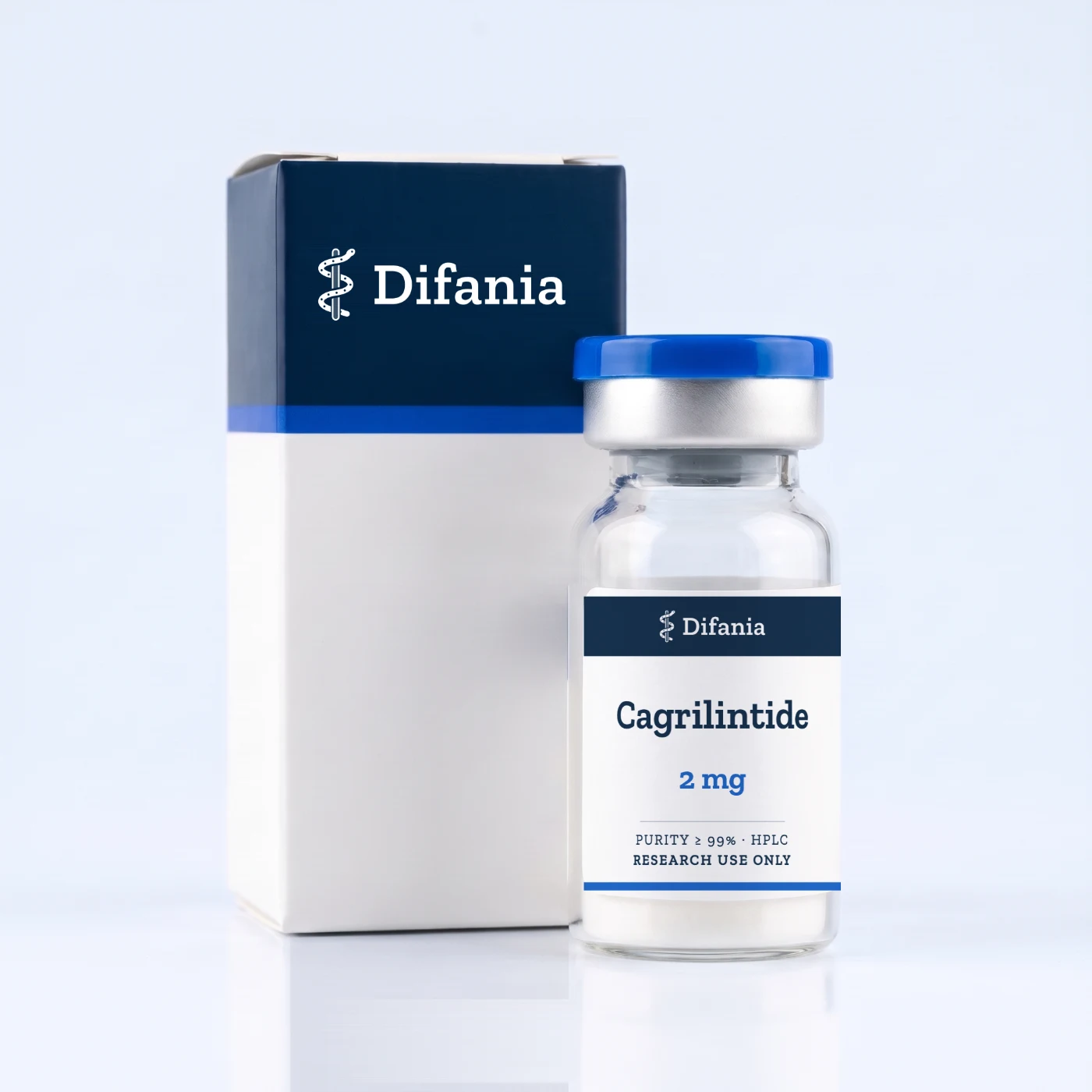
Cagrilintide in the laboratory
Identification
Cagrilintide is a synthetic peptide held in the incretin analogue group of the Difania catalogue and supplied as a lyophilised solid in sealed vials. Four fill weights are listed: 2 mg, 5 mg, 10 mg and 20 mg of peptide, all of one material released against one specification.
What the catalogue record does not hold is worth stating plainly, because it changes how the material is described at the bench. No CAS number, no molecular formula and no molar mass is carried for this entry, so none is quoted here, on the label or in the listing. Two practical consequences follow. First, a stock solution made from this material is described by weight, in mg/mL, rather than in molar units, since molarity cannot be derived without a molar mass; a laboratory that needs it establishes it from its own determination. Second, the identifier that matters in correspondence and in the notebook is the lot number on the vial, which is what the analytical documentation is filed against.
The same peptide is catalogued in three two component vials, Cagrilintide + Semaglutide, Retatrutide + Cagrilintide and Tirzepatide + Cagrilintide, in each of which it is freeze dried with a second peptide in fixed proportion. The single compound listed here is the form to take when the proportion is to be chosen by the laboratory rather than fixed at filling.
Analytical control
Purity is determined by reversed phase high performance liquid chromatography. The material is separated on the column and the area of the main peak is expressed against the total area of the chromatogram; the specification is 99% or higher. The minor peaks around the main one are the related species a peptide synthesis leaves behind, truncated and deletion sequences among them, and a chromatogram turns them into a profile that can be compared from lot to lot.
Identity is a separate question, answered by mass spectrometry, the measured mass being compared against the value expected for the peptide. Since the catalogue listing publishes no mass figure for this entry, that comparison sits in the documentation held for the lot rather than in the catalogue text, which is one more reason to ask for the paperwork.
Reconstitution and solubility
Let the solvent run down the inside wall of the vial onto the cake, leave it for a minute and then swirl. The solid enters an aqueous solvent at room temperature without heating, and shaking achieves nothing except foam.
| Vial | Solvent added | Resulting concentration |
|---|---|---|
| 2 mg | 1 mL | 2 mg/mL |
| 5 mg | 2 mL | 2.5 mg/mL |
| 10 mg | 2 mL | 5 mg/mL |
| 20 mg | 4 mL | 5 mg/mL |
Bacteriostatic water, sterile water and a dilute acetic acid solution are the usual options, and the table shows arithmetic rather than a recommendation.
Storage and stability
Keep the unopened vial at minus 20 degrees Celsius, dry and in the dark. Allow it to warm to room temperature before the seal is broken, so that air moisture does not settle on cold solid. Once in solution the material is held at 2 to 8 degrees Celsius and is best split into single use portions straight away, since each cycle of warming and chilling costs more than an equivalent span of time spent undisturbed in the cold.
Use in the laboratory
The material is supplied for in vitro work and for use as a reference substance in analytical and method development work. Cagrilintide appears in metabolic and endocrine research, and a single component vial gives the comparator against which fixed ratio blends of the same peptide can be run. Difania supplies the reagent and the analytical documentation held for its lot, and leaves the design of the experiment to the laboratory.
Safety and handling
Gloves and eye protection are worn while the vial is open and while solutions are prepared, and the bench should be free of draughts because a lyophilised cake is light. Disposal of residues, spent solutions and empty glass follows the rules of your institution and the local regulations in force. This is a laboratory chemical and nothing besides: not a medicinal product, food, supplement or cosmetic, and not intended for consumption or for administration to humans or animals.
Lot documentation
The lot number printed on the vial is the thread back to everything held on the material. Quote it and Difania can retrieve the analytical documentation filed for that lot. In the laboratory it belongs in the notebook next to the date the vial was opened and the solvent used, which is what allows a result to be tied to one defined batch rather than to a product name.


