
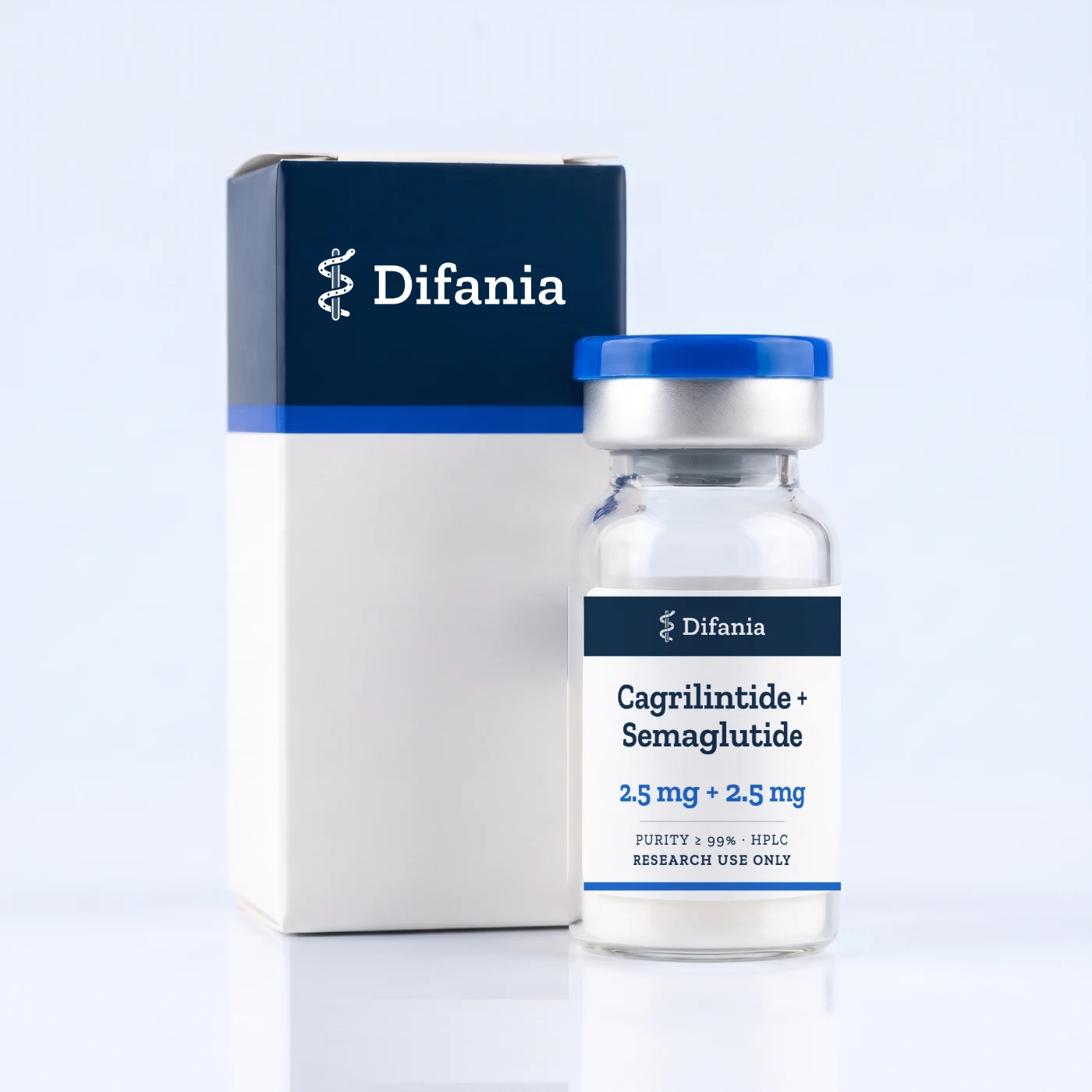
Cagrilintide + Semaglutide in the laboratory
Composition
The vial holds two peptides freeze dried together in a single cake, cagrilintide and semaglutide, present in equal amounts. Three fill weights are catalogued: 2.5 mg + 2.5 mg, 5 mg + 5 mg and 10 mg + 10 mg, where the first figure gives the cagrilintide content and the second the semaglutide content. The item is listed in the incretin analogue group, and both compounds are also catalogued on their own, where the identifiers held for each of them appear in their own records.
A co-lyophilisate is not the same thing as two vials standing side by side. The proportion was set at filling and cannot be altered afterwards; both peptides enter solution in the same step; neither can be sampled without the other. That is an advantage where a fixed ratio is what the work calls for, since it removes a weighing step and the error that goes with it, and a limitation where the ratio itself is the variable. In the second case the single compounds are the right items to order.
Analytical control
Both components are released against a purity specification of 99% or higher, established by reversed phase high performance liquid chromatography. The mixture is separated on the column, and because the two peptides elute as distinct peaks the chromatogram also shows that both are present and in what relation to one another. Identity is confirmed separately by mass spectrometry, each component being matched against the mass expected for it.
The two methods answer different questions. Chromatography reports how much of the sample is the intended substance; mass spectrometry says what that substance is. A record giving only one of the two leaves half the question open, which is why the documentation held for a lot covers both.
Reconstitution and solubility
Bring the vial to room temperature first, so that moisture does not condense on a cold cake when the seal is broken. Direct the solvent against the inner wall of the vial rather than onto the solid, wait a minute, then swirl until the solution is clear. Both peptides dissolve in aqueous media without heating, and vigorous shaking only raises foam.
| Vial | Solvent added | Concentration of each component |
|---|---|---|
| 2.5 mg + 2.5 mg | 1 mL | 2.5 mg/mL |
| 5 mg + 5 mg | 2 mL | 2.5 mg/mL |
| 10 mg + 10 mg | 2 mL | 5 mg/mL |
Because the two are present in equal amounts, one figure describes the concentration of both, which is one of the conveniences of a one to one fill.
Storage and stability
The sealed cake keeps at minus 20 degrees Celsius, dry and shielded from light, until the day it is wanted. Reconstituted material is held at 2 to 8 degrees Celsius and divided into single use portions as soon as it is made, so that the bulk of the solution is never warmed and chilled again at each sampling. Note the date of reconstitution on the vial. For a blend this matters a little more than for a single peptide, because anything that degrades one component changes the ratio in the vial as well as the total amount of material in it.
Use in the laboratory
The blend is supplied for in vitro work and as a reference material in analytical and method development work, where a fixed ratio mixture is useful for checking that a separation resolves two peptides and that a detector responds to both. Material of this kind appears in metabolic and endocrine research. Difania supplies the reagent and the analytical documentation held for its lot; what is done with it, and how the results are read, remain matters for the laboratory.
Safety and handling
This is a laboratory chemical. Gloves and eye protection are worn while the vial is open and throughout the preparation of solutions, and the bench is kept free of draughts, since the dry cake is light. Residues, spent solutions and empty vials go to disposal under the rules of your institution and the local regulations in force there. It is not a medicinal product, not a food or supplement and not a cosmetic, nor is it intended for consumption or for administration to humans or animals.
Lot documentation
Every vial is marked with a lot number covering both components as they were filled together. Quote that number and Difania can retrieve the analytical documentation held for the lot. Record it in the laboratory notebook alongside the date the vial was opened and the solvent added, so that a result found later can still be traced to one defined filling rather than to a catalogue name.


