
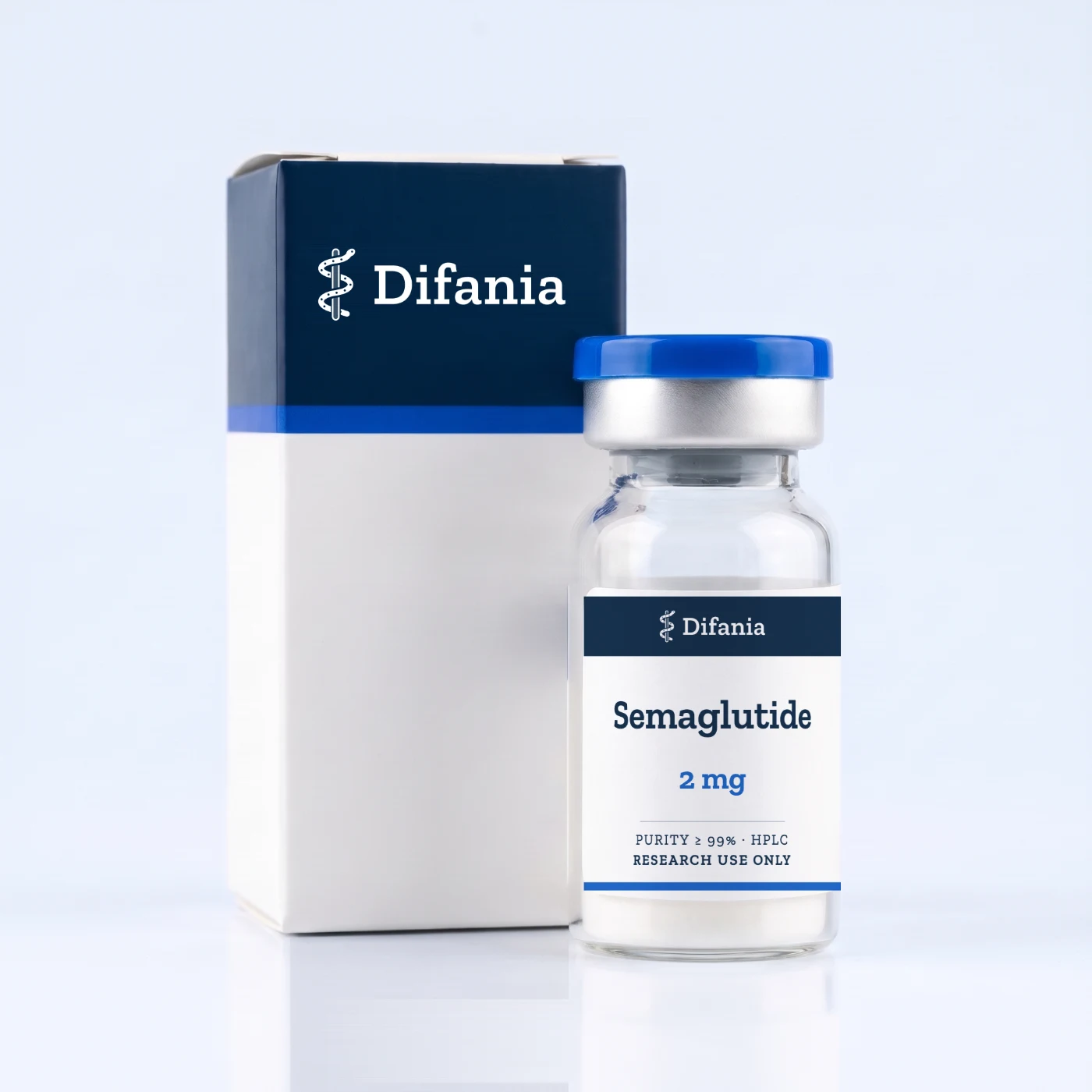
Semaglutide in the laboratory
Identification
Semaglutide is a synthetic peptide listed in the incretin analogue group of the catalogue and supplied as a lyophilised solid. Three identifiers are held for it: CAS 910463-68-2, the molecular formula C187H291N45O59 and a molar mass of 4113.6 g/mol. Of the three, the CAS number is the one that identifies the substance unambiguously across suppliers and databases, so it belongs in the purchase record as well as in the notebook.
The formula describes a long chain, one hundred and eighty seven carbon atoms with forty five nitrogen and fifty nine oxygen atoms, a composition dominated by amide bonds and polar side chains. The practical consequence is a solid that dissolves in aqueous media without organic solvents and a dry cake that readily takes up atmospheric moisture. No sulphur is present, so there is no thiol to oxidise and no disulphide bridge to maintain during handling.
Using the molar mass, one milligram amounts to about 0.24 micromoles. A 2 mg vial therefore holds roughly 0.49 micromoles and a 50 mg vial roughly 12 micromoles. Eight fill weights are catalogued, 2 mg, 5 mg, 10 mg, 15 mg, 20 mg, 30 mg, 40 mg and 50 mg, the 2 mg fill being the smallest offered in this group. The same peptide is also catalogued in a two component vial, Cagrilintide + Semaglutide, where it is freeze dried together with a second peptide.
Analytical control
Identity is established by mass spectrometry. The measured mass of the material is compared with 4113.6 g/mol, the figure that follows from the formula. For a chain of this size the comparison is sharp: an incorrect or missing residue displaces the mass far beyond the uncertainty of the measurement.
Purity is established by reversed phase high performance liquid chromatography, with a specification of 99% or higher. The peptide is separated on the column, the main peak is integrated and its area is expressed against the total area of the chromatogram. The small remainder is made up of related species such as truncated and deletion sequences, which the chromatogram resolves into a readable profile rather than leaving as an unknown.
Reconstitution and solubility
Add the solvent slowly against the wall of the vial so that it runs down onto the cake rather than striking it. Leave the vial to stand for a minute, then swirl gently until the liquid is clear. Shaking only produces foam, a sign of mechanical stress at the surface rather than of faster solution.
| Vial | Solvent added | Resulting concentration |
|---|---|---|
| 2 mg | 1 mL | 2 mg/mL |
| 10 mg | 2 mL | 5 mg/mL |
| 20 mg | 4 mL | 5 mg/mL |
| 50 mg | 5 mL | 10 mg/mL |
These combinations are examples of the same division. Any volume may be used, provided the figure is written down where the solution can be traced back to it.
Storage and stability
Before opening, the vial stays at minus 20 degrees Celsius, dry and protected from light, and it is brought to room temperature on the bench before the seal is broken. Afterwards the solution belongs at 2 to 8 degrees Celsius and is best divided into portions at the moment it is made: what shortens the usable life of a peptide solution is usually the number of warming and chilling cycles it has been through, not the number of days it has stood.
Use in the laboratory
The material is supplied for in vitro work and as a reference substance in analytical and method development work, where a peptide of known mass and defined purity is needed to qualify a separation or a detector response. Semaglutide appears in metabolic and endocrine research. Difania supplies the reagent together with the analytical documentation held for its lot and does not advise on experimental design or on the interpretation of results.
Safety and handling
Wear gloves and eye protection whenever the vial is open or a solution is being prepared, and work on a clean bench away from draughts, since a freeze dried cake is easily disturbed. Residues, spent solutions and used glass are disposed of under the rules of your institution and the local regulations that apply to them. The material is a chemical reagent: not a medicinal product, not a food or supplement, not a cosmetic, and not intended for consumption or for administration to humans or animals.
Lot documentation
Each vial bears a lot number. Quoting it allows Difania to retrieve the analytical documentation held for that lot, so an enquiry about a particular vial is answered precisely rather than in general terms. Record the number in the laboratory log beside the date the vial was first opened, and the chain between a result and the material behind it stays unbroken.


