
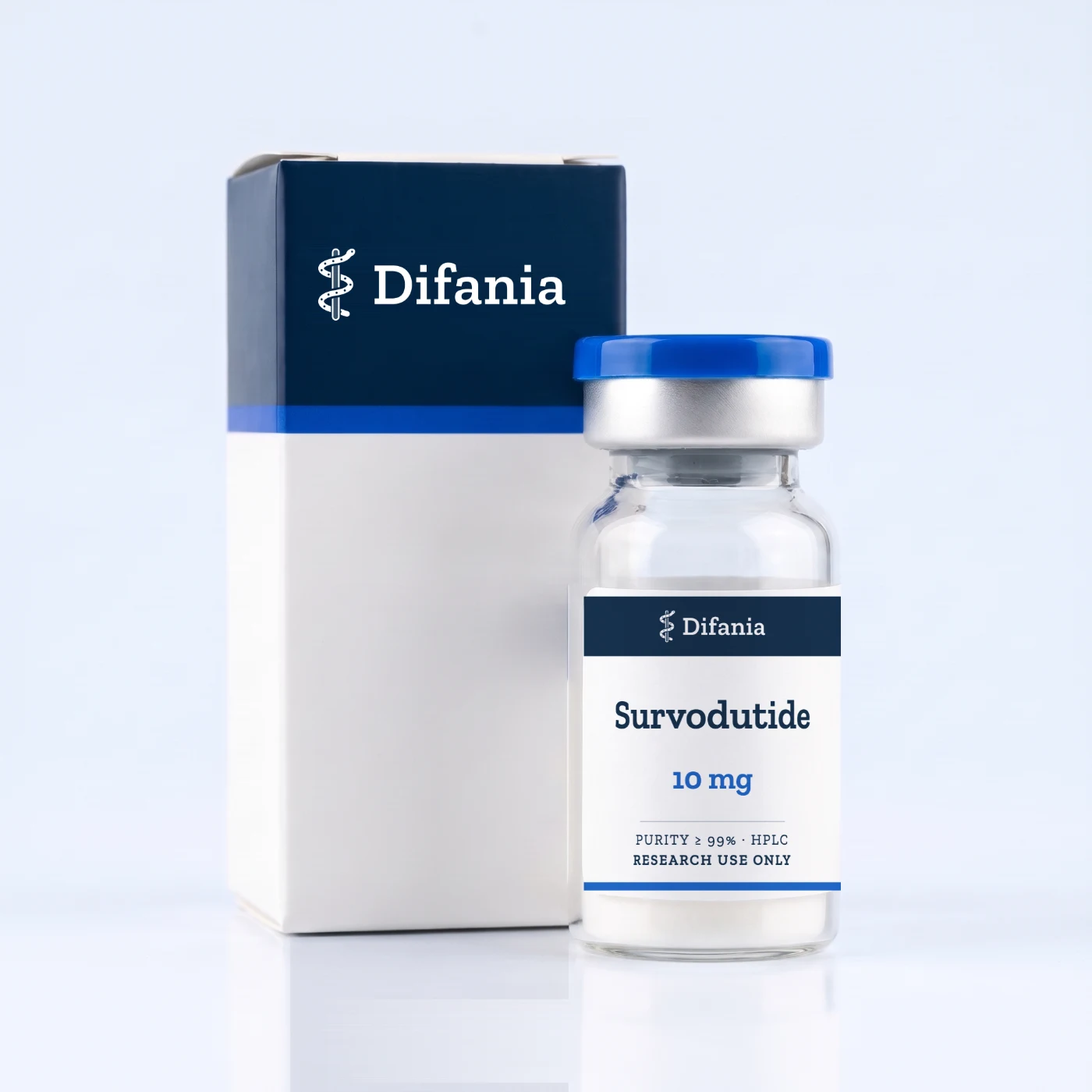
Survodutide in the laboratory
Identification
Survodutide sits in the Difania catalogue among the incretin analogues and leaves the fill line as a lyophilised solid under a crimped seal. One fill size is listed, 10 mg of peptide per vial, and one quality figure, a purity of 99% or higher. The record holds no CAS number, no molecular formula, no molar mass and no sequence listing, so none is quoted on this page. What fixes the identity of the material is the analytical work carried out on the lot rather than a published registry entry, and the paperwork issued for that lot is the correct reference for a goods inward record or a chemical register. The item is catalogued on its own and appears in no combined vial in the range. Lyophilised peptide occupies very little volume, so expect a thin film or a small plug against the glass rather than a filled vial.
Analytical control
Two techniques carry the release of this material. Reversed phase HPLC resolves the peptide from related substances and from residues left behind by synthesis and purification, and the integrated main peak is read against the catalogue specification of 99% or higher. Mass spectrometry supplies the identity check, setting the measured mass against the value expected for the synthesised chain. Both results belong to a single lot and are filed under its number, which is why the figure printed on the label matters more than any general statement about the product line.
Reconstitution and solubility
Bring the vial up from the freezer and leave it closed until the glass has reached room temperature. Add solvent slowly against the inner wall so that the stream does not strike the cake directly, then swirl gently, or simply let the vial stand, until the solid has cleared. Keep a vortex mixer away from material that has not yet dissolved.
| Vial size | Solvent added | Resulting concentration |
|---|---|---|
| 10 mg | 1 mL | 10 mg/mL |
| 10 mg | 2 mL | 5 mg/mL |
| 10 mg | 5 mL | 2 mg/mL |
Bacteriostatic water suits a stock that will be sampled on several occasions, sterile water a solution prepared and used within one session, and a dilute acetic acid solution the case where water alone leaves the cake slow to clear.
Storage and stability
Unopened, the solid belongs at minus 20 degrees Celsius, sealed and shielded from light, and it is best left in that state until the day of use. Once solvent has been added, hold the solution at 2 to 8 degrees Celsius and portion it out while it is being made, so that a single stock is not carried through repeated cycles of warming and cooling. Equilibrating a cold vial to room temperature before opening keeps condensation off the contents.
Use in the laboratory
The material is offered for in vitro experiments and for use as a reference standard, for example while an analytical method is being established or verified. Incretin analogues form a class encountered in metabolic and receptor pharmacology research, and this entry is catalogued for laboratories working in that area. Difania provides the reagent itself together with the analytical documentation recorded for its lot. Difania does not advise on experimental design, on the choice of protocol or on how a result should be read.
Safety and handling
Treat the contents as a laboratory chemical from the moment the outer packaging is opened. Gloves and eye protection belong on while the vial is open and while solutions are drawn or diluted, and dry solid should be handled inside whatever containment your laboratory applies to fine powders. Residues, spent solutions and empty glassware go to waste under the rules of your institution and the local regulations covering laboratory waste. The material is not a medicinal product, a food, a supplement or a cosmetic, it is not for consumption, and it is not for administration to humans or to animals.
Lot documentation
Every vial carries a lot number on its label. That number is the link between the glass on your bench and the analytical documentation Difania holds, and quoting it is all that is needed for those records to be retrieved. Write it into your own notes next to the date the vial was first opened, so that any later result can be traced back to the lot it came from.


