
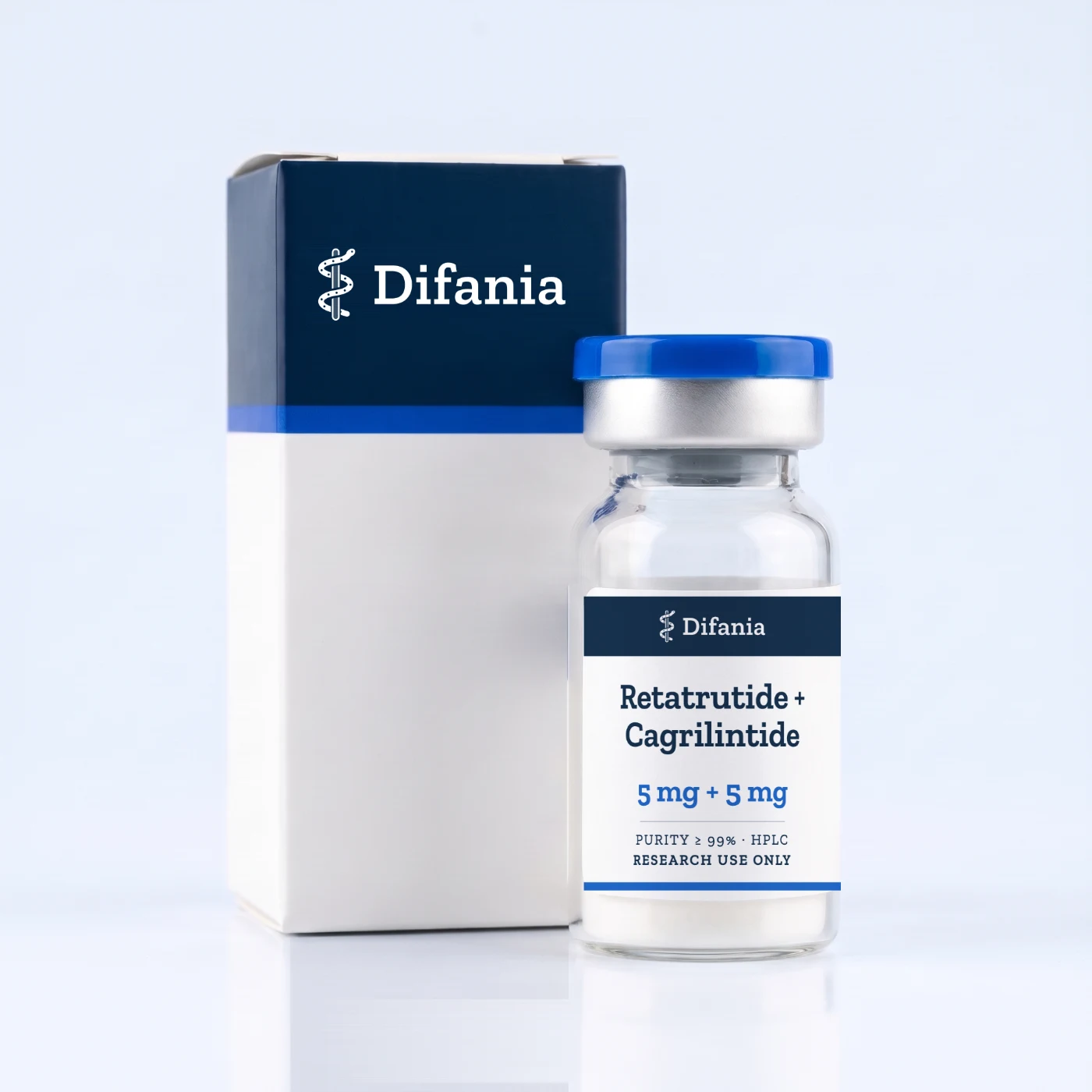
Retatrutide + Cagrilintide in the laboratory
Composition
This catalogue item is a blend: two synthetic peptides, retatrutide and cagrilintide, dried from one solution so that they form a single cake in a single sealed vial. Both are listed under incretin analogues, and both are present here in equal amounts. Two fill weights are catalogued, 5 mg + 5 mg and 10 mg + 10 mg, where the first figure is the retatrutide content and the second the cagrilintide content.
The format decides how the material behaves at the bench. One addition of solvent brings both peptides into solution at once, in the proportion they were dried in, and that proportion is fixed for the life of the vial. Nothing in a co-lyophilisate can be weighed out separately afterwards, so a laboratory that needs another ratio orders the two compounds as separate catalogue entries and combines them itself. What the blend removes in exchange is a weighing step and the variation that comes with it, which is the usual reason a fixed ratio vial is chosen for comparative work.
Analytical control
Both components are released against a purity specification of 99% or higher. Purity comes from reversed phase high performance liquid chromatography: the sample is separated on the column and the area of each main peak is integrated against the whole chromatogram, which also carries truncated chains, deletion sequences and residues left over from synthesis. Identity comes from mass spectrometry, the measured mass of each component read against the mass expected for that peptide.
A blend makes the chromatogram worth reading rather than filing. Two peptides mean two main peaks, and the retention behaviour of each belongs to the record held for the lot.
Reconstitution and solubility
Bring the sealed vial to room temperature before the seal is broken, then add solvent slowly down the inner wall rather than straight onto the cake. Swirl until the solution runs clear. Shaking and vortex mixing put a peptide solution under more stress than it needs.
| Vial | Solvent added | Concentration of each component |
|---|---|---|
| 5 mg + 5 mg | 2 mL | 2.5 mg/mL |
| 10 mg + 10 mg | 2 mL | 5 mg/mL |
| 10 mg + 10 mg | 4 mL | 2.5 mg/mL |
Bacteriostatic water is the usual solvent where a vial will be entered on several occasions, sterile water where no preservative is wanted, and a dilute acetic acid solution where the cake is slow to clear. The table is arithmetic rather than advice: any other volume is equally valid and the concentration simply follows from it.
Storage and stability
Keep the vial sealed at minus 20 degrees Celsius, dry and shielded from light, until the day it is used. After reconstitution the solution belongs at 2 to 8 degrees Celsius, divided into portions at the moment it is made, so that the whole volume is not warmed and chilled again every time it is sampled. Allow a cold vial to reach room temperature before opening, and write the reconstitution date on the label.
Use in the laboratory
The blend is supplied for in vitro work and for use as a reference material when analytical methods are being developed or checked. Peptides of this class appear in metabolic and endocrine research, and a fixed ratio co-lyophilisate gives a convenient starting point for comparison against the single components. Difania supplies the material and the analytical documentation held for its lot, and does not advise on experimental design, which stays with the laboratory running the work.
Safety and handling
Gloves and eye protection belong on while the vial is open and while solutions are prepared, and the dry solid is light, so work out of a draught. Residues, spent solutions and used glass go to laboratory waste under the rules of your institution and the local regulations that cover chemical waste. This is a research chemical and nothing else: not a medicinal product, not a food, not a supplement, not a cosmetic, and not for consumption or for administration to humans or animals.
Lot documentation
Every vial carries a lot number. Give that number to Difania and the analytical documentation held for the lot can be retrieved and sent to you. Copy it into your own records beside the date the vial was opened, so that a result produced weeks later still points back to a defined batch of material.


