
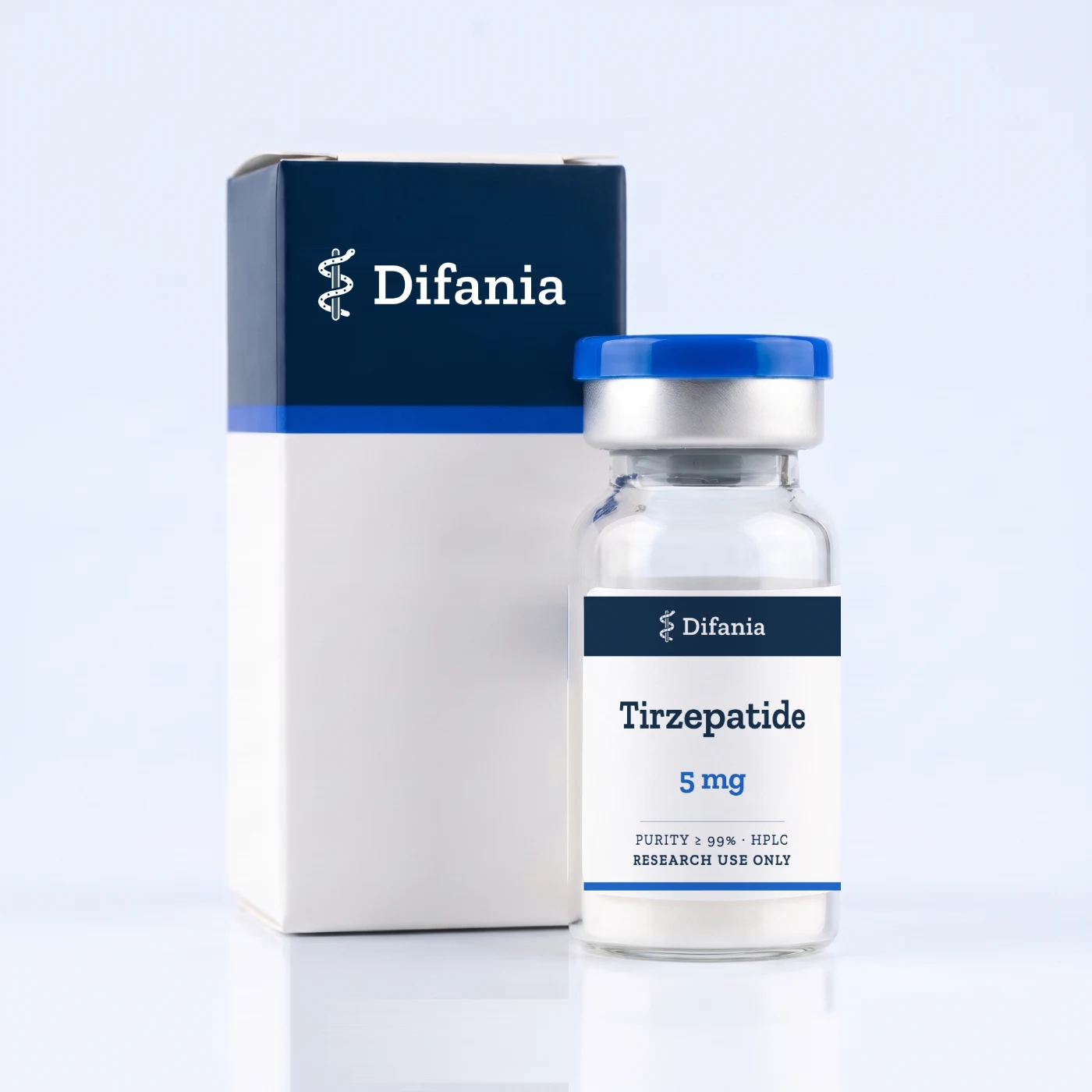
Tirzepatide in the laboratory
Identification
Tirzepatide is a synthetic peptide catalogued among the incretin analogues and supplied as a lyophilised solid. The record holds CAS 2023788-19-2, the molecular formula C225H348N48O68 and a molar mass of 4813.5 g/mol.
Read as a working description rather than a label, the formula sets out what the bench can expect. Forty eight nitrogen atoms mark a long backbone of amide bonds, and sixty eight oxygen atoms make the molecule markedly polar, so water based solvents are the obvious first choice and the dry cake is hygroscopic enough to deserve a closed vial. The formula contains no sulphur, which means no free thiol and no disulphide bridge to protect, and therefore no reducing agent and no special atmosphere during reconstitution.
The molar mass turns weights into amounts of substance. One milligram corresponds to roughly 0.21 micromoles, so a 5 mg vial holds about 1.0 micromole and a 120 mg vial about 25 micromoles. Eleven fill weights are catalogued: 5 mg, 10 mg, 15 mg, 20 mg, 30 mg, 40 mg, 50 mg, 60 mg, 80 mg, 100 mg and 120 mg. The same peptide also appears in a two component vial, Tirzepatide + Cagrilintide, in which it is freeze dried together with a second peptide and cannot be recovered from it separately.
Analytical control
Two methods answer two different questions, and neither answers both.
Mass spectrometry settles identity. The measured mass is compared with 4813.5 g/mol, the value that follows from the formula. On a chain of this length a single missing residue moves the result well beyond the scatter of the instrument, so the comparison is decisive.
Reversed phase HPLC settles purity. The sample is separated on the column and the main peak is integrated against the whole chromatogram; the specification for this material is 99% or higher. The minor peaks are not noise but a profile of the related species that a long synthesis leaves behind, which is why the chromatogram is worth looking at rather than only the number taken from it.
Reconstitution and solubility
Direct the solvent against the inner wall of the vial, not onto the cake itself, and give it a minute before swirling. The solid goes into an aqueous solvent at room temperature; heating is unnecessary and vigorous shaking only raises foam at the surface.
| Vial | Solvent added | Resulting concentration |
|---|---|---|
| 10 mg | 2 mL | 5 mg/mL |
| 30 mg | 6 mL | 5 mg/mL |
| 60 mg | 12 mL | 5 mg/mL |
| 120 mg | 12 mL | 10 mg/mL |
The table is arithmetic rather than advice. Bacteriostatic water, sterile water or a dilute acetic acid solution all serve, and the choice belongs to the method in use.
Storage and stability
Hold the unopened vial at minus 20 degrees Celsius, dry and out of the light, until the day it is wanted, and let it warm to room temperature on the bench before the seal is broken, otherwise water condenses onto cold solid. After reconstitution the solution belongs at 2 to 8 degrees Celsius, and the few minutes spent dividing it into single use portions spare the bulk of the material the repeated warming and chilling that comes of returning to one vial again and again.
Use in the laboratory
The material is supplied for in vitro work and as a reference standard in analytical and method development work, where a defined peptide of known mass and purity is needed to qualify a column, a gradient or a detector response. Tirzepatide appears in metabolic and endocrine research. Difania provides the reagent and the analytical documentation held for its lot; the design of the experiment, and the interpretation of what it yields, remain with the laboratory.
Safety and handling
Handled as what it is, a laboratory chemical, the material presents no unusual difficulty: gloves and eye protection while the vial is open and while solutions are being prepared, and a bench free of draughts, since a freeze dried cake is light enough to be disturbed by one. Spent solutions, residues and empty glass go to disposal under the rules of your institution and the local regulations that apply to it. The material is not a medicinal product, food, supplement or cosmetic, nor is it intended for consumption or for administration to humans or animals.
Lot documentation
Every vial carries a lot number, and that number is the key to everything Difania holds on the material behind it. Send it with any enquiry and the analytical documentation for that lot can be retrieved. In the laboratory, copy it into the notebook next to the date the vial was opened and the solvent that went into it, so that a result read back months later still points to a defined material rather than to a name.


