
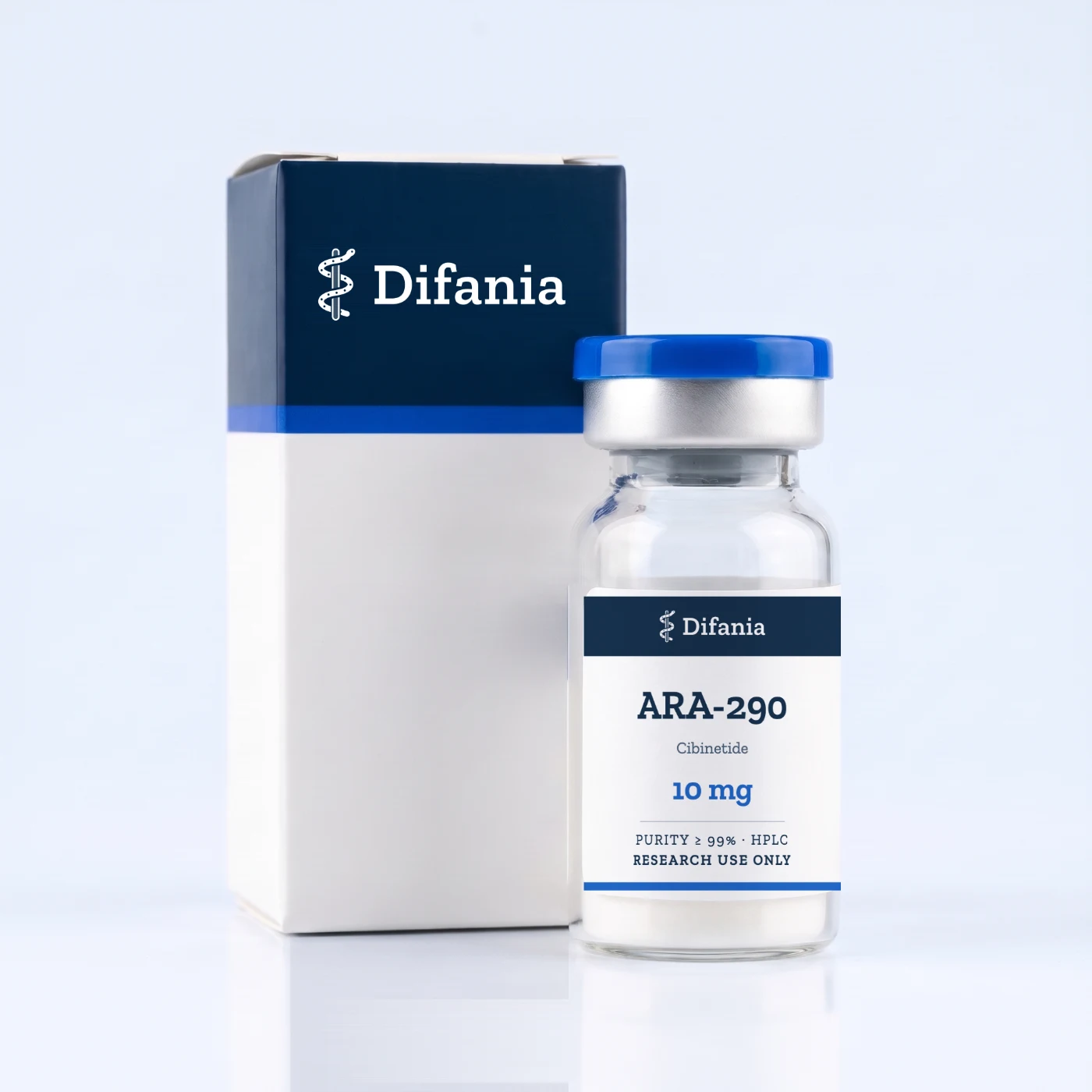
ARA-290 (Cibinetide) in the laboratory
Identification
ARA-290, catalogued together with its second name cibinetide, is a short synthetic peptide supplied as a lyophilised solid and held in the tissue research group. The record for this entry is deliberately thin, and that is the first thing a buyer should know about it: it carries the form, a purity specification of 99 percent or higher and two fill sizes, 10 mg and 16 mg of peptide. No CAS number, molecular formula, molar mass or sequence is entered against the product, so none is stated here. A short peptide of this kind reaches the vial as a freeze dried cake from solid phase synthesis followed by preparative purification, and the properties that matter at the bench, how readily the cake clears and how a solution behaves on standing, are governed by that history rather than by any figure a catalogue page could supply. The lot paperwork is where the material itself is described.
Analytical control
The purity specification attached to this item is established by reversed phase HPLC, the standard separation for synthetic peptides, in which the main peak is resolved from the related substances that remain after synthesis and cleavage. Identity is confirmed by mass spectrometry on the intact peptide, with the measured value reported in the documentation issued for the lot. Because the catalogue holds no calculated mass for this entry, that documentation rather than this page is the reference against which a result should be read.
Reconstitution and solubility
Warm the vial to room temperature first, then add solvent in a slow stream against the inside wall of the glass. Bacteriostatic water, sterile water and a dilute acetic acid solution are the solvents in normal use. Tip the vial gently from side to side until the cake has gone and the liquid is clear and colourless. Do not shake: a solution that has been foamed leaves material on the stopper and in the neck.
| Vial | Solvent added | Resulting concentration |
|---|---|---|
| 10 mg | 2 mL | 5 mg/mL |
| 10 mg | 5 mL | 2 mg/mL |
| 16 mg | 2 mL | 8 mg/mL |
| 16 mg | 4 mL | 4 mg/mL |
| 16 mg | 8 mL | 2 mg/mL |
Storage and stability
Unopened stock belongs at minus 20 degrees Celsius, sealed and in the dark. That is the condition in which a lyophilised solid holds up best, and there is no reason to disturb it before the day of use. Solution is another matter: once made, it is kept at 2 to 8 degrees Celsius and is best divided immediately into portions, each sized for one session, so the whole stock is not carried in and out of the cold. Equilibrate any vial to room temperature before opening it.
Use in the laboratory
The material is supplied for in vitro experiments and for use as a reference substance in analytical work such as method development and system suitability testing. Peptides of this kind appear in tissue protection and peripheral nerve research. Difania supplies the reagent and the analytical documentation held for its lot, and takes no part in experimental design, in the choice of conditions or in how results are interpreted.
Safety and handling
The contents are a laboratory chemical. Gloves and eye protection are the minimum whenever the vial is open or solution is being transferred, and the exposed powder is best kept out of draughts. Residues, rinsings and used labware are disposed of under your institution’s rules and the local waste regulations that apply. It is not a medicinal product, not a food, not a supplement and not a cosmetic. It is not for consumption, and it is not for administration to humans or to animals.
Lot documentation
The number printed on the vial label identifies the lot, and it is what connects the vial on your bench to the analytical documentation Difania holds. Quoting it in a message is all that is required for that documentation to be sent over. Note the number in the laboratory record alongside the date of opening and the solvent used for reconstitution, so that a later result never has to be matched to a batch from memory.


