
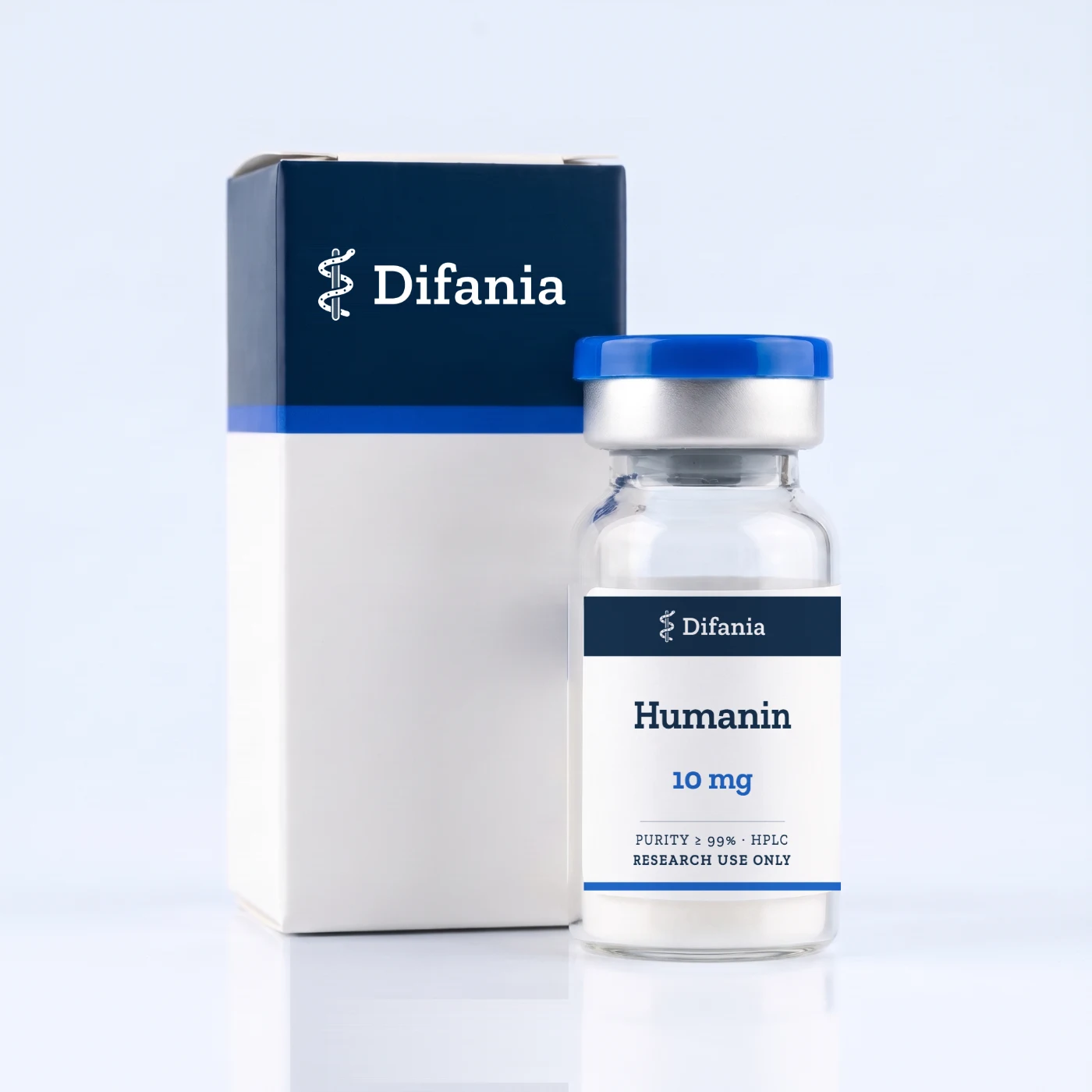
Humanin in the laboratory
Identification
Humanin is a synthetic peptide catalogued under cellular ageing and supplied as a lyophilised solid in a single fill size of 10 mg per vial, at a purity specification of 99% or higher. The record gives the CAS number 330936-69-1, the molecular formula C119H204N34O32S2 and a molar mass of 2687.2 g/mol. The formula contains two sulphur atoms, and that is the feature that matters most at the bench, because sulphur-containing peptides call for care against oxidation during storage and handling. The molar mass places the material among the larger peptides in the range, so weighing should be done on a balance with adequate resolution for a 10 mg fill.
Analytical control
Purity is determined by reversed phase high performance liquid chromatography. The main peak is integrated against the full chromatogram, related substances and process residues are separated from it, and the result is compared with the specification of 99% or higher. Identity is established by mass spectrometry, where the measured mass is checked against the 2687.2 g/mol calculated from C119H204N34O32S2. Both sets of data are recorded against the lot number on the label.
Reconstitution and solubility
Allow the sealed vial to reach room temperature before it is opened. Add the solvent slowly down the inner wall of the vial, not onto the solid, and then swirl gently or let the vial rest until the solid has dissolved. Bacteriostatic water is the usual solvent for a stock drawn from repeatedly, sterile water suits a solution made for immediate use, and a dilute acetic acid solution is an option where the cake is slow to clear in water alone.
| Vial size | Solvent added | Resulting concentration |
|---|---|---|
| 10 mg | 2 mL | 5 mg/mL |
| 10 mg | 1 mL | 10 mg/mL |
The two rows show the working concentrations that the single vial supports. Choose the one that suits the protocol, and keep the choice consistent across a series.
Storage and stability
The sealed solid is held at minus 20 degrees Celsius and shielded from light until it is needed. Reconstituted material is kept at 2 to 8 degrees Celsius, and it is most practical to divide the solution into portions as it is made, so that each withdrawal leaves the rest of the stock sealed. Because of the sulphur content, keep the time the solution spends open to air as short as possible, and return unused portions to the cold without delay.
Use in the laboratory
The material is supplied for in vitro experiments and for use as a reference material. The catalogue places Humanin in cellular ageing research, and this entry is offered to laboratories working in that field. Difania supplies the peptide together with the analytical documentation filed for its lot. It does not advise on experimental design and does not interpret the outcome of any work carried out with the material.
Safety and handling
Gloves and eye protection belong on whenever the vial is open or a solution is being transferred, and the dry solid should be handled inside the containment your laboratory applies to fine powders. Residues, rinses and used labware are disposed of under the rules of your institution and the local regulations that apply to it. This is a laboratory chemical, not a medicinal product, food, supplement or cosmetic. It is not for consumption and not for administration to humans or animals.
Lot documentation
Each vial carries a lot number on its label, and quoting that number to Difania allows the analytical documentation filed for the lot to be retrieved. Write the lot number down with the date the vial was opened and the solvent used. A record kept this way lets any later observation be matched to one specific fill.


