
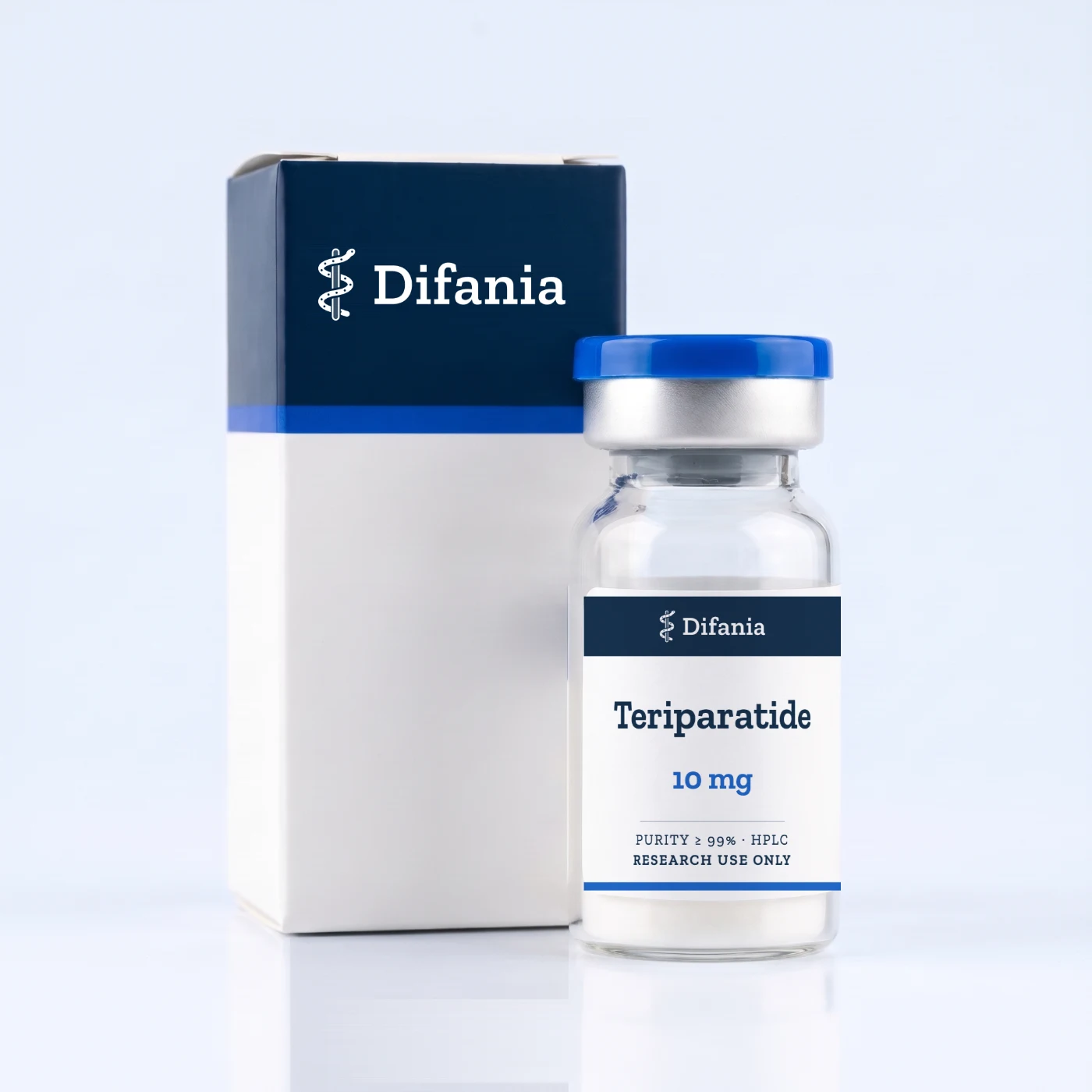
Teriparatide in the laboratory
Identification
Teriparatide is a synthetic peptide, listed by Difania in the cellular ageing range. The item is a lyophilised solid sold in one fill size of 10 mg per vial, and its purity specification is 99% or higher. The catalogue lists the CAS registry number 52232-67-4, the molecular formula C181H291N55O51S2 and a molar mass of 4117.7 g/mol. Read from that formula, the molecule contains 55 nitrogen atoms and two sulphur atoms. Its molar mass is large, so every molar calculation should use the catalogue value of 4117.7 g/mol rather than a figure taken from another source.
Analytical control
Each lot is checked by reversed phase HPLC, which separates the principal component from minor related substances and from residues carried over from manufacture. The share of the principal component is read against a 99% or higher specification. Identity is confirmed by mass spectrometry, with the observed mass set against the 4117.7 g/mol predicted from C181H291N55O51S2. Both results are stored under the lot number printed on the vial, so the pair can be retrieved together.
Reconstitution and solubility
Let the sealed vial reach room temperature before the seal is broken. Dispense the chosen solvent along the inner glass wall, keeping it clear of the solid, then rock the vial gently until no particles remain. Bacteriostatic water is the right choice for a stock sampled repeatedly, sterile water for a solution prepared shortly before use, and dilute acetic acid for a cake that stays cloudy in plain water.
| Vial | Added solvent | Concentration |
|---|---|---|
| 10 mg | 0.5 mL | 20 mg/mL |
| 10 mg | 4 mL | 2.5 mg/mL |
The first row produces a concentrated stock that calls for careful small-volume pipetting. The second gives a dilute working solution. Settle on one of the two before reconstituting, because switching concentrations partway through a series complicates comparisons between preparations.
Storage and stability
Keep the unopened powder at minus 20 degrees Celsius, protected from light. A solution belongs at 2 to 8 degrees Celsius. Portioning the liquid as it is made keeps the main volume closed for longer. Because the formula contains sulphur, keep solutions capped, limit the time they spend at room temperature, and put any unused material back in the cold promptly.
Use in the laboratory
The material is intended for in vitro studies and as a reference standard. The catalogue assigns it to cellular ageing research, and the entry is aimed at laboratories working in that field. Difania provides the peptide together with the analytical records for its lot. Design of experiments and the reading of results stay with the buyer, because Difania offers no guidance on either.
Safety and handling
Use gloves and eye protection throughout, including whenever liquid is moved, and contain the dry powder as you would any fine solid. Waste and rinsings go to disposal under institutional procedure and local law. The item is a laboratory chemical. It is not a medicinal product, a foodstuff, a supplement or a cosmetic. Do not consume it or give it to people or animals.
Lot documentation
Each vial is marked with a lot number, and that number is how Difania locates the analytical file for the lot. Quote it in any request. Keep a note of the lot number, the day the seal was broken and the solvent used, so that later observations stay linked to one fill.


