
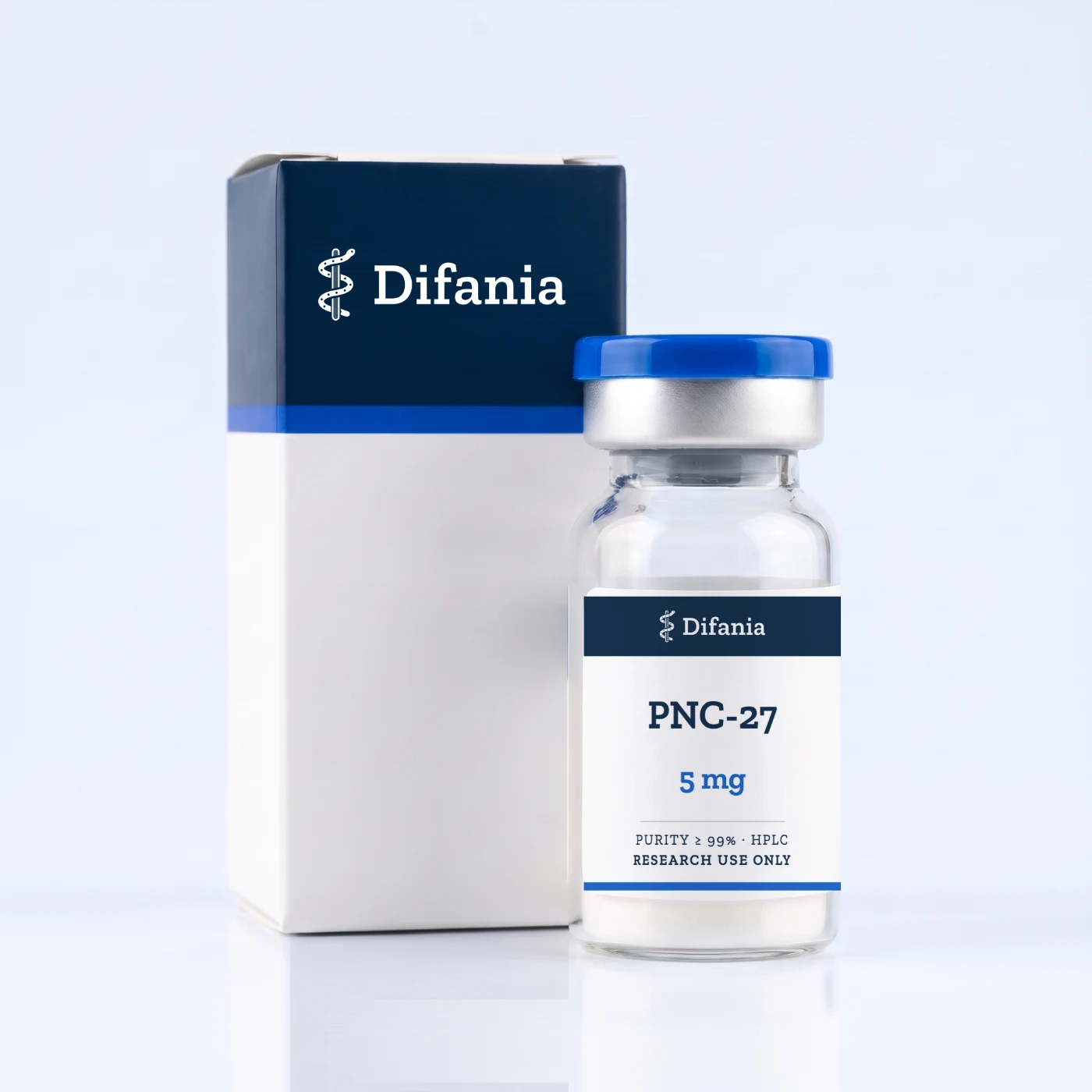
PNC-27 in the laboratory
Identification
PNC-27 is a synthetic peptide catalogued under cellular ageing and supplied as a lyophilised solid. Two fill sizes are catalogued, 5 mg and 10 mg per vial, and both are specified at a purity of 99% or higher. The catalogue entry is the reference for the material’s identity and its lot record, and the label on each vial carries the lot number that links the physical fill to its documentation. Because the two sizes are filled from the same material, a protocol written for one vial can be carried over to the other by adjusting the solvent volume so that the working concentration stays the same.
Analytical control
Purity is determined by reversed phase high performance liquid chromatography. The main peak is integrated against the full chromatogram, related substances and process residues are separated from it, and the result is read against the specification of 99% or higher. Identity is established by mass spectrometry, with the measured mass compared against the value expected for the material. The chromatographic result and the mass result are both filed against the lot number, so each vial can be traced to a complete set of records.
Reconstitution and solubility
Bring the sealed vial to room temperature before opening it. A cold vial draws condensation onto the powder, which can make the cake slow to dissolve and can leave moisture in the stock. Add the solvent slowly down the inner wall of the vial, never directly onto the solid, and then swirl gently or let the vial rest until the solid has gone into solution. Bacteriostatic water is the usual choice for a stock that will be drawn from repeatedly, sterile water suits a solution made for one session, and a dilute acetic acid solution is an option where the cake clears slowly in water alone.
| Vial size | Solvent added | Resulting concentration |
|---|---|---|
| 5 mg | 1 mL | 5 mg/mL |
| 10 mg | 2 mL | 5 mg/mL |
Both sizes give the same working concentration with the volumes shown, which keeps a protocol consistent when the vial size changes between orders.
Storage and stability
Hold the sealed solid at minus 20 degrees Celsius, out of light, until the material is required. Reconstituted solution is kept at 2 to 8 degrees Celsius. Dividing the solution into working portions while it is being prepared means that each withdrawal leaves the remainder sealed, and a thawed portion is better used than returned to the freezer. Let a frozen vial reach room temperature before the stopper is disturbed.
Use in the laboratory
The material is supplied for in vitro experiments and for use as a reference material. The catalogue places PNC-27 in cellular ageing research, and this entry is listed for laboratories working in that field. Difania supplies the peptide together with the analytical documentation filed for its lot. It does not advise on experimental design or on the interpretation of any results obtained with the material.
Safety and handling
Wear gloves and eye protection whenever a vial is open or a solution is being transferred, and handle the dry solid within the containment your laboratory applies to fine powders. Residues, rinses and used labware go to waste under the rules of your institution and the local regulations that apply to it. This is a laboratory chemical and not a medicinal product, food, supplement or cosmetic. It is not for consumption, and it is not for administration to humans or animals.
Lot documentation
The label of every vial bears a lot number. Quote it when you contact Difania, and the analytical documentation filed for that lot can be retrieved. Record the lot number beside the date the vial was opened and the solvent that was used, so that a later result can always be traced back to one specific fill.


