
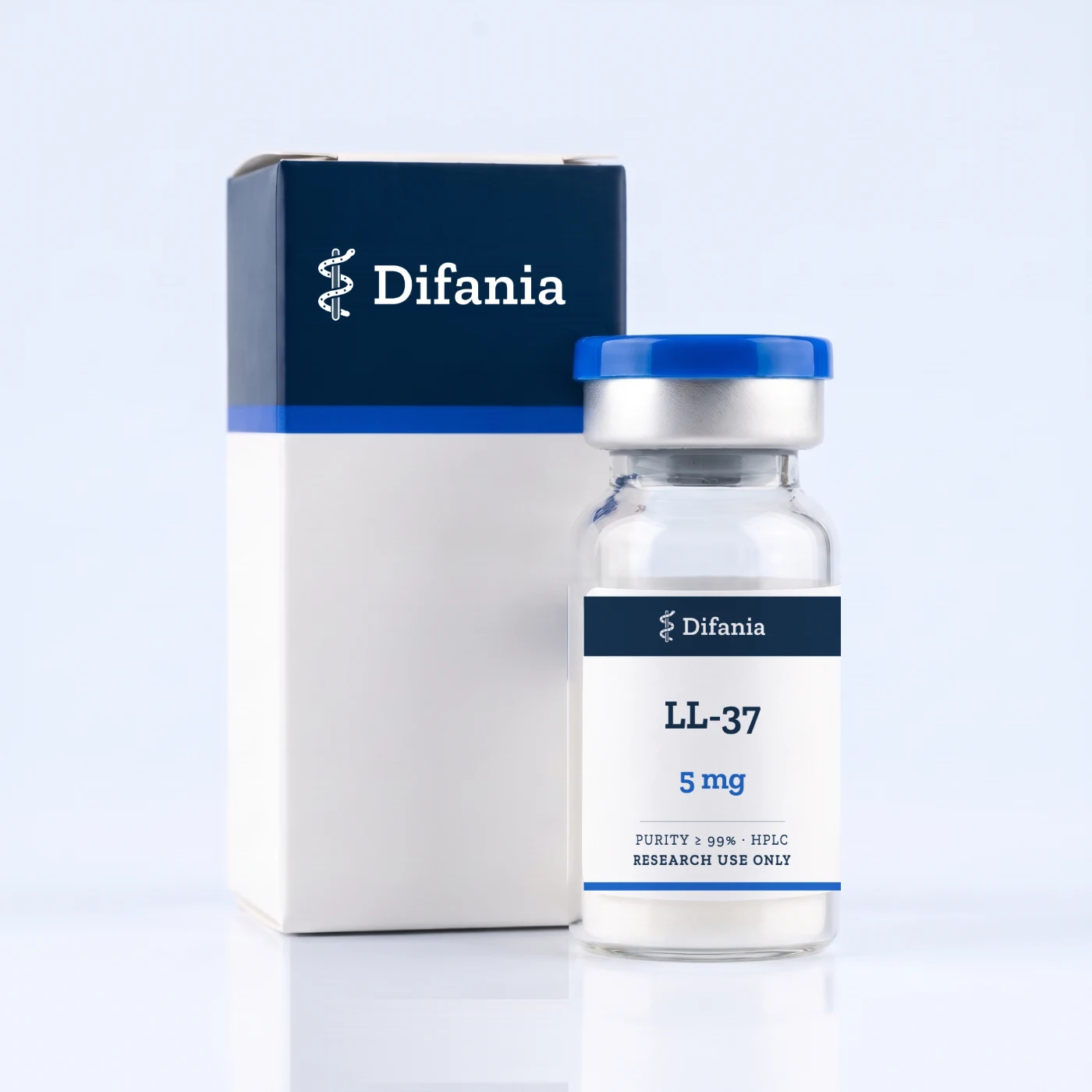
LL-37 in the laboratory
Identification
LL-37 is a cathelicidin, one of the cationic, amphipathic host defence peptides that fold into an amphipathic helix in membrane mimicking solvents and remain largely unstructured in plain water. Difania supplies it as synthetic material in lyophilised form and lists it in the tissue research group of the catalogue. The record holds CAS 154947-66-7, the molecular formula C205H340N60O53 and a molar mass of 4493.3. The high proportion of nitrogen in that formula is what a chemist would expect from a sequence rich in basic residues, and it is the reason the solid behaves the way it does when a solvent is chosen. One fill size is catalogued: 5 mg of peptide per vial. No sequence listing, salt form or counter ion figure is entered against this item, so the documentation issued with the lot remains the reference for anything beyond the values above.
Analytical control
Two independent methods stand behind the material. Reversed phase HPLC resolves the main peak from the deletion and truncation products that synthesis leaves behind, and it is the measurement against which the purity specification of 99 percent or higher is applied. Mass spectrometry confirms identity by comparing the measured mass of the intact peptide with the value calculated from the catalogued formula. The results that describe your vial are the ones recorded for its own lot.
Reconstitution and solubility
Let the vial equilibrate on the bench, then run solvent slowly down the inside wall of the glass rather than straight onto the cake. Rotate the vial until the liquid is clear and colourless. Shaking is counterproductive: foam carries peptide into the headspace and leaves it on the stopper.
| Vial | Solvent added | Resulting concentration |
|---|---|---|
| 5 mg | 1 mL | 5 mg/mL |
| 5 mg | 2 mL | 2.5 mg/mL |
| 5 mg | 5 mL | 1 mg/mL |
Storage and stability
The lyophilised solid is the stable form, and it should stay sealed at minus 20 degrees Celsius, protected from light, until the work is ready for it. Once a solvent has been added the picture changes: keep the solution at 2 to 8 degrees Celsius, and split it into portions as it is made rather than returning to one tube again and again. Whatever the vial holds, solid or solution, bring it to room temperature before the stopper is pierced.
Use in the laboratory
The material is supplied for in vitro experiments and for use as a reference substance, for instance as a characterised standard when a chromatographic method is being developed or a mass spectrometry workflow checked. Peptides of this class appear in innate immunity research and in work on peptide membrane interactions. Difania provides the reagent and the analytical documentation belonging to its lot, and does not advise on experimental design, conditions or the reading of results.
Safety and handling
Treat the contents as a laboratory chemical whose hazards are not fully characterised. Gloves and eye protection belong on whenever the vial is open or a solution is being transferred, and fine lyophilised powder is best handled where airborne dust is controlled. Residues, rinsings and spent vials go to waste under your institution’s rules and the local regulations that apply to it. The material is not a medicinal product, a food, a supplement or a cosmetic, and it is neither for consumption nor for administration to humans or animals.
Lot documentation
A lot number is printed on the label of every vial. That number is how Difania finds the analytical documentation held for the filling, so quoting it in an enquiry is all that is needed to have the paperwork sent across. Copy it into your own log next to the date the vial was opened and the solvent used, and a result stored months later can still be traced to the material behind it.


